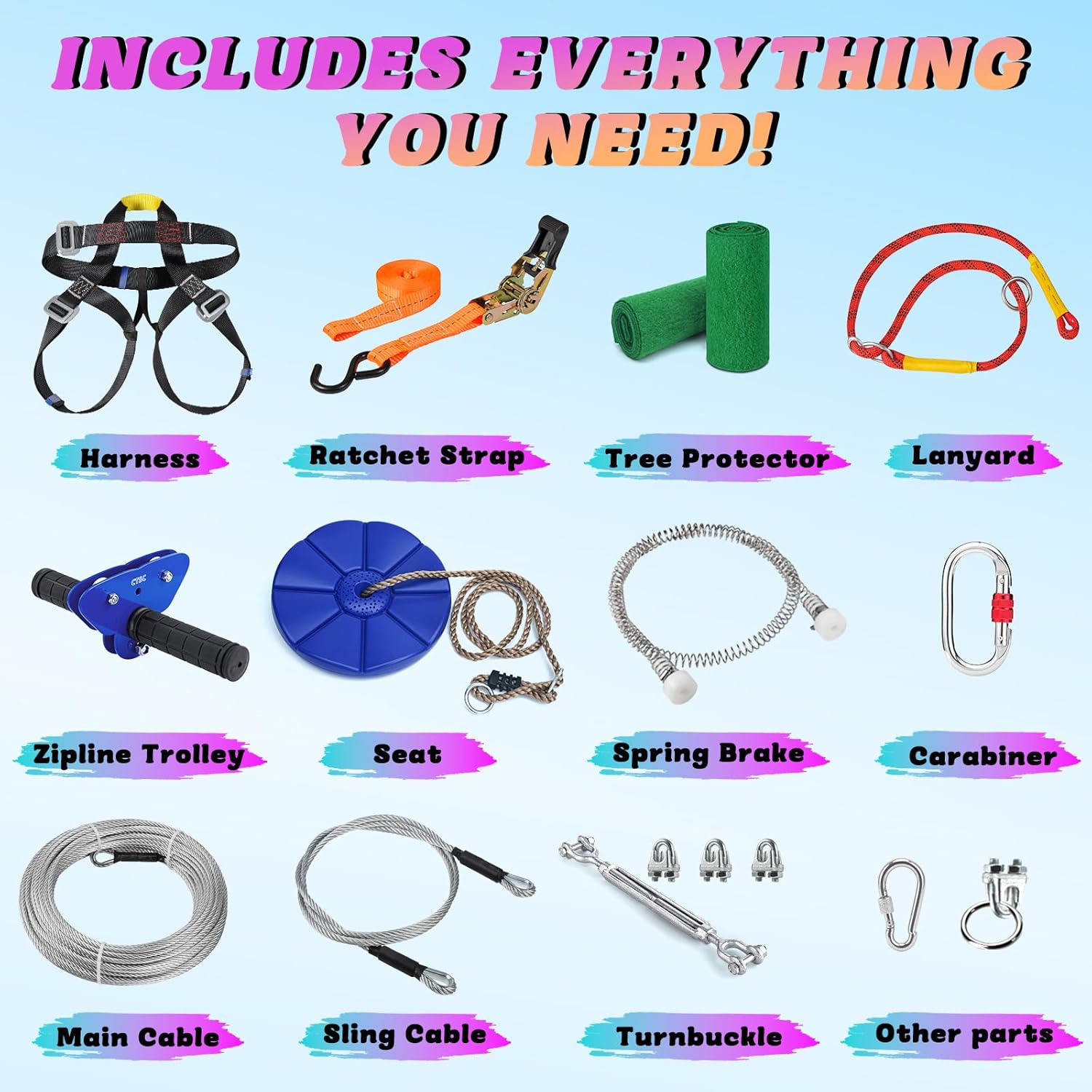
A backyard zipline sounds simple: string a cable between two trees, hang a trolley (the wheeled carriage that rides the cable), clip in a harness or seat, and let gravity do the work. In practice, the single variable that separates a thrilling afternoon from a trip to the emergency room is one that most product listings bury in fine print — the weight rating, meaning the maximum load the entire system is engineered to handle safely. That number is set by the weakest component in the chain: cable, trolley, anchor hardware, or the tree attachment itself. If any one of those components sees a force it wasn’t designed for, the whole system can fail. This guide is for buyers who already know what a zipline kit is and are now making a real purchasing decision — likely with specific riders in mind, a yard or property already scoped, and a budget in hand. We’ll break down how to read weight ratings honestly, show you where the popular kit tiers actually land, and give you a clear decision framework so you don’t overbuy — or, more dangerously, underbuy.
| EDITOR'S PICK[Zip Line Kit for Kids and Adults](https://www.amazon.com/dp/B0C4N7BD4G?tag=greenflower20-20) | Mid-tier[CTSC Zipline for Kids and Adult](https://www.amazon.com/dp/B0DHL1MQ3G?tag=greenflower20-20) | Budget pick[X XBEN 180FT Zip line Kits for](https://www.amazon.com/dp/B0CH9R9P3S?tag=greenflower20-20)… | |
|---|---|---|---|
| Max Weight | 350 Lbs | — | — |
| Length options | 100/120/150/200 ft | — | 180 ft |
| Material | Stainless Steel | Stainless Steel | Steel |
| Brake type | — | Spring Brake | Ziplines Brake |
| Swing seat | ✗ | ✗ | ✓ |
| Harness incl. | ✓ | ✓ | ✗ |
| Price | $209.99 | $139.99 | $109.99 |
| See on Amazon → | See on Amazon → | See on Amazon → |
Why the Stated Weight Rating Is Almost Never the Whole Story
Here’s the frustration most intermediate buyers hit: a kit says “rated to 250 lbs” on the box, your ten-year-old weighs 85 lbs, and you feel safe. But that rating is a static load rating — it measures the force the hardware can withstand when a weight hangs motionless. A moving rider generates dynamic load, which is meaningfully higher due to the physics of swinging, stopping abruptly at the brake, and the jerk of a flying mount. Industry engineers often apply a safety factor (a multiplier that builds in margin for dynamic forces, material fatigue, and installation variables) of 5:1 to 10:1 on consumer gear. That means a component rated at 250 lbs static load may be designed to handle only 25–50 lbs of actual dynamic rider weight before the margin disappears.
The CPSC’s Outdoor Home Playground Safety Handbook flags this gap explicitly, noting that dynamic loading from swinging and impact can multiply static forces by a factor of two to four in typical play scenarios. The ACCT’s Standards for Challenge Courses and Canopy/Zip Line Tours, 7th Edition, requires commercial zipline components to carry a minimum 5:1 safety factor on the design load — meaning a component rated to hold 5,000 lbs of force is approved for a 1,000 lb design load. Consumer kits are not held to ACCT standards, but the physics don’t care about the regulatory category.
The practical takeaway: when a budget kit says “250 lb capacity,” read that as a ceiling for static loads, not a green light for a 240 lb adult riding at speed onto a tree-mounted brake. Cross-reference the trolley rating, the cable breaking strength (cable manufacturers publish this as MBS, minimum breaking strength), and the anchor hardware rating — then apply a conservative 5:1 factor yourself.
The Three Budget Tiers: What You’re Actually Buying
Starter Kits ($80–$250): Slackers, ZipKrooz, SkyWalker
These are the kits that arrive in one box from a big-box retailer or major online marketplace. Based on published specs across the product lines, they share a recognizable profile:
- Cable: Typically 1/4-inch or 5/16-inch galvanized steel wire rope, 50–100 feet in length
- Trolley: Stamped steel or cast zinc alloy with sealed bearings; manufacturer-rated at 150–250 lbs depending on the model
- Braking: Bungee-cord or rubber stop block at the end anchor — passive, fixed, not adjustable
- Intended user: Kids ages 5–12, under 150 lbs per most published specs
The ZipKrooz line, for example, publishes a 250 lb weight limit on its larger configurations, while the base Slackers NinjaLine-adjacent kits often cap at 150–175 lbs depending on the specific component. SkyWalker’s zip line kits list 150 lbs on most current models per their published product documentation.
Here is where the decision gets concrete for a practitioner buyer: these kits are designed and engineered for children, and the hardware reflects that. The trolley wheel diameter and cable diameter are sized for low speeds and light loads. If you have a child who is 10 years old and 95 lbs, a well-installed starter kit is likely appropriate. If you have a mix of kids and participating adults — say a 200 lb parent who wants to demonstrate — the starter kit is underspecified, even if the stated weight limit technically accommodates that weight.
SaferParks’ public incident review data on recreational ziplines consistently identifies brake failure and overloading as the leading mechanical causes of injuries on consumer-grade equipment. The bungee brake on a starter kit is calibrated for a child’s approach speed. An adult at the same cable pitch arrives faster, with more kinetic energy, and hits that bungee stop with forces the system was not designed to absorb.
The Intermediate Tier ($500–$1,500): Where the Decisions Actually Get Interesting
This is the tier most practitioners are working in when they reach this article. You’ve outgrown the starter kit concept. You’re specifying components — or evaluating configured kits from vendors like Zip Line Gear or AnytimeZiplines — and the tradeoffs become real.
By the numbers — published specs for common intermediate-tier components:
| Component | Spec | Working Load Limit |
|---|---|---|
| 3/8” 7x19 galvanized cable | MBS ~14,400 lbs | ~2,880 lbs at 5:1 |
| 1/2” stainless cable | MBS ~26,600 lbs | ~5,320 lbs at 5:1 |
| Zip Line Gear Pro Trolley | Rated 350 lbs | Published WLL |
| Inline brake (spring-assisted) | 300–400 lbs per manufacturer | Model-specific |
At this tier, the cable is no longer the limiting factor — a properly tensioned 3/8-inch galvanized line has a working load limit that vastly exceeds any single rider. The bottleneck shifts to the trolley and brake system matching.
The core decision frame here is: span length drives brake selection, and brake selection constrains your rider weight ceiling.
A 150-foot span on a moderate pitch (roughly 6–8% grade, which is the sweet spot for a 10–15 mph ride) will bring a 200 lb adult in noticeably faster than a 100 lb child on the same line. An inline spring brake — the type that uses a progressive resistance coil mounted mid-cable — is adjustable for approach speed, which is why it’s the correct choice for any intermediate build with mixed rider weights. Bungee brakes are not. The ASTM F2959 standard for aerial adventure courses explicitly requires braking systems to be matched to the design rider weight and speed parameters — a principle that transfers directly to serious DIY builds even when commercial certification isn’t required.
Petzl’s technical documentation for its zipline-adjacent hardware notes that harness and connector loads should be calculated at a minimum of the rider’s body weight plus dynamic factors, and warns against applying consumer-grade static ratings to dynamic activity contexts. That’s the manufacturer telling you to run your own math.
Matching Riders to Hardware: The Decision Framework
If you’re building or buying right now, here is the if/then logic that collapses the options:
If your rider population is children only, all under 150 lbs, span under 100 feet: A quality starter kit (ZipKrooz large, Slackers premium line) properly installed is likely adequate. Verify the published weight limit against your heaviest rider with a 20% margin — so a 150 lb kit should be used only for riders up to 120 lbs to preserve safety factor. Install a proper cable tensioner and inspect tree attachment points annually. The CPSC playground safety guidelines recommend hardware inspection at least twice yearly for outdoor equipment subjected to weather cycling.
If you have adult riders, mixed ages, or spans over 100 feet: Move to intermediate-tier components minimum. Specify a trolley rated to at least 350 lbs with sealed stainless bearings (not sealed zinc — stainless holds up to weather cycles over years of use, and owners of intermediate builds consistently report zinc trolleys degrading within two to three seasons in humid or coastal climates). Pair with an adjustable inline brake rather than a bungee stop. Budget $600–$900 for cable, trolley, brake, and anchor hardware at this tier.
If you are building for a camp, rental property, or situation with public or commercial use: Consumer-tier equipment — any of the above — is not appropriate, regardless of weight ratings. ACCT standards apply to any commercial zipline operation, and many states have adopted ASTM F2959 as the regulatory baseline for commercial adventure activities. Engage a certified challenge course professional (ACCT maintains a professional registry) before specifying components. At this tier, Petzl, Kong, and Rock Exotica hardware is appropriate; consumer kits are not.
Installation Variables That Change the Math
Weight ratings assume proper installation. Two variables that practitioners frequently underestimate:
Cable sag: A cable that sags more than engineered — because it was under-tensioned or the trees have shifted — changes the angle at which the rider’s weight is applied to the anchor. Per published engineering references in challenge course literature, even a few degrees of angular change at the anchor can significantly increase the horizontal force component on a tree-mounted eye bolt. If you are using tree attachments, size them for the actual tension load at your specific cable geometry, not the trolley’s weight limit.
Anchor tree health: A cable tensioned to 200–400 lbs of line tension (typical for a 150-foot span) is applying a continuous horizontal load to a living tree. A compromised tree — rot at the core, root damage, prior storm stress — can fail at loads well below what healthy wood of the same species would tolerate. Have a certified arborist assess any anchor tree before installation. This is not an optional precaution; SaferParks’ incident database includes anchor tree failures as a recurring cause category in zipline incidents.
The Bottom Line
The weight rating printed on a backyard zipline kit is a starting point, not a safety guarantee. Your job as the buyer is to cross-reference the trolley, cable, brake, and anchor hardware as a system — then apply a realistic safety factor to your actual rider weights under dynamic (moving) conditions. For children under 150 lbs on short spans, quality starter kits are a reasonable choice when properly installed and inspected. For adult riders, spans over 100 feet, or any mixed-use scenario, intermediate-tier components with adjustable braking are not a luxury — they’re the minimum responsible specification. And for anything that touches commercial or quasi-public use, step entirely off the consumer hardware ladder and engage certified professionals before you purchase a single bolt.
The math is not complicated. What it requires is the discipline to run it before the kit arrives, not after the first rider hits the brake stop.