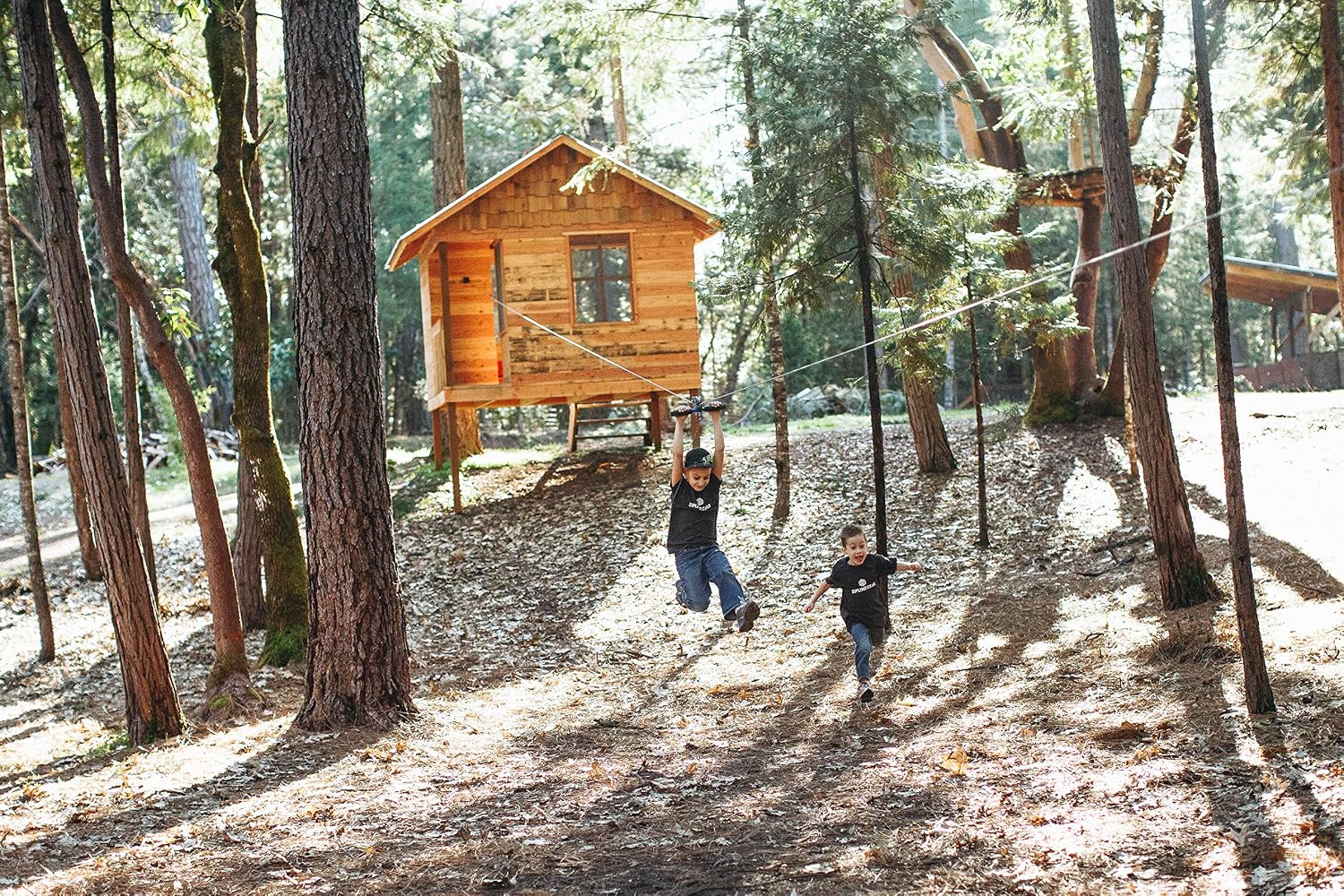
Long-Span Ziplines 150–250 ft: Cable Sag, Rider Clearance, and Adult-Rated Builds
A zipline is, at its simplest, a steel cable stretched between two anchor points with a trolley — the wheeled carriage that riders grip or harness into — rolling down the slope. At 50 or 80 feet, the physics stay forgiving: the cable barely sags, average speeds stay modest, and most packaged kits handle the job. But stretch that span to 150, 200, or 250 feet and a new set of forces takes over. The cable sags more than most people expect. Rider speeds climb significantly. And the braking systems that are perfectly adequate on a backyard starter kit become the most dangerous component on a long run if they haven’t been properly matched. This article is for builders who are past the “which kit do I buy?” question and are now asking the harder ones: How much clearance do I actually need at mid-span? What cable diameter and tension spec keeps the ride safe for adults? And how do I build a system that won’t embarrass me — or hurt someone — two years from now?
Why Sag Is the Number You Have to Own First
Cable sag — the vertical distance the midpoint of a taut cable droops below a straight line drawn between its two anchor endpoints — is the most consequential variable in any long-span build, and the one most consistently underestimated by first-time intermediate builders.
The engineering here is not a mystery. A cable under tension behaves according to catenary geometry: a curve defined by the cable’s own weight per foot versus the horizontal tension applied. The practical implication is that sag increases with the square of the span length and inversely with tension. Double the span, and sag quadruples at the same tension. Cut tension by half, and sag doubles. On a 100-foot run you might see 8–12 inches of sag under a 250 lb rider. On a 250-foot run with the same anchoring approach, that number can easily reach 36–48 inches or more, depending on cable diameter, slope, and tensioning hardware.
The ACCT Standards for Challenge Courses and Canopy/Zip Line Tours (13th Edition) require that all zipline designs document minimum ground clearance under maximum design load — including rider weight plus dynamic loading — at the lowest point of the cable path, which is almost always mid-span or slightly downhill of it. ACCT guidelines call for clearance appropriate to the site and termination method, but adventure-course operators routinely work to a 10-foot minimum under full load for open-ground commercial builds, with adjustments for terrain, netting, or catch systems.
For a private property build where you’re not operating commercially, you have more latitude — but not as much as you might think. The CPSC’s Handbook for Public Playground Safety (Publication 325) flags overhead cable equipment as a fall-hazard zone requiring careful clearance evaluation. The principle transfers directly: mid-span ground clearance under a loaded cable should not drop below 7–8 feet for adult-weight riders on a long-span backyard build, and 10–12 feet is a more comfortable safety buffer on spans over 175 feet.
The practical move: Before you finalize anchor heights and hardware, run the sag calculation at your planned tension, your cable’s weight-per-foot rating (which varies significantly between 3/16-inch and 5/16-inch stainless), and your maximum expected rider weight. Free catenary calculators are available from engineering reference sites; the ACCT and ASTM F2959 documents both reference the underlying formula. Doing this on paper before you pour footings has saved more than a few builders from an expensive rebuild.
Cable Diameter and Tensioning Hardware: The 150–250 ft Decision Matrix
Here’s where the tradeoff between cost, weight, and safety margin becomes concrete. At 150–250 feet, you’re working in territory where 3/16-inch 7×19 stainless steel cable — the default for most kits — starts to show its limits for adult riders.
By the numbers:
| Cable diameter | Approximate breaking strength | Approximate weight (lb/ft) | Typical sag at 250 ft / 800 lb tension |
|---|---|---|---|
| 3/16 in (7×19 SS) | ~4,200 lb | 0.10 | ~42 in |
| 1/4 in (7×19 SS) | ~7,000 lb | 0.16 | ~28 in |
| 5/16 in (7×19 SS) | ~9,800 lb | 0.25 | ~20 in |
(Specifications per Loos & Co. published wire rope data; sag values are illustrative at equal tension for comparison only.)
The standard engineering rule for zipline cable is a minimum 5:1 safety factor against the design load — meaning your cable’s breaking strength should be at least five times the maximum expected load, including the rider’s weight multiplied by a dynamic load factor (typically 1.5–2× static weight to account for impact at the trolley). For a 250 lb adult, that means a design load of roughly 375–500 lb, requiring a cable rated to at least 1,875–2,500 lb breaking strength. By that math, 3/16-inch cable clears the threshold on paper — but it leaves almost no additional margin for multi-rider loading, cable wear, or anchor flex.
At spans over 175 feet with adult riders, 1/4-inch cable is the pragmatic minimum for serious builders. At 200–250 feet with riders over 200 lb or any potential for two riders on a tandem system, 5/16 inch is worth the weight and tensioning hardware cost.
Tensioning matters just as much as diameter. On runs over 150 feet, hand-tightened turnbuckles — the threaded adjusters commonly included in starter kits — cannot apply or hold sufficient tension to control sag at adult weights. Operators and serious DIY builders working with Zip Line Gear components or AnytimeZiplines rigging configurations typically move to cable come-alongs for initial tensioning combined with heavy-duty 5/8-inch or 3/4-inch galvanized turnbuckles (rated to 4,000–6,000 lb working load) for permanent tension maintenance. The ACCT Standards explicitly require that tensioning hardware be rated to match the cable system’s design load — not just any hardware that threads onto the end of a cable.
Brake System Matching: The Spec You Cannot Improvise
SaferParks incident data consistently identifies inadequate or improperly specified braking as one of the leading contributors to zipline injuries in both commercial and private installations. On a 150–250 foot span, the stakes are qualitatively different from a shorter run.
A rider on a properly sloped 200-foot zipline will reach 20–28 mph at a typical 6–8% grade by mid-span — faster with a steeper approach, faster still if the span is long enough to build sustained speed before the line angle flattens. At those speeds, a spring-loaded bungee brake (standard on most kit packages under $300) is not a primary brake; it’s an arrester for a rider who is already nearly stopped. Using it as the sole braking mechanism on a 200-foot run with an adult rider is the single most predictable failure mode in the intermediate builder’s toolkit.
For long-span adult-rated builds, the decision framework looks like this:
-
150–175 ft, rider under 200 lb, 6–8% grade: A quality inline spring brake from a brand like Zip Line Gear or SkyHighZiplines, sized to the cable diameter, is defensible as a primary brake if the brakeline geometry is set correctly — meaning the brake engages with enough line remaining to decelerate the rider to under 5 mph before the end anchor. Owners of these configurations consistently report that brake placement (not just brake type) is the variable that separates a smooth stop from an end-anchor collision.
-
175–250 ft, any adult rider, or any run over 200 lb: An inline auto-brake or friction brake — Petzl’s ZipLoc system, Kong’s Zip Speed, or Rock Exotica’s trolley systems designed for adventure course use — represents the appropriate hardware tier. Per Petzl’s published technical notice for the ZipLoc system, it is rated for riders up to 286 lb (130 kg) and engineered to self-regulate stopping force based on rider speed. ASTM F2959 effectively endorses this class of hardware for commercial aerial adventure courses, and the same logic applies at the upper end of residential long-span builds.
The cost differential is real: a basic spring brake setup runs $40–$80. A Petzl ZipLoc or comparable system runs $200–$400 at current 2026 pricing. But on a $1,200–$2,000 long-span build with adult riders, braking hardware is the wrong place to find margin.
Anchor Engineering: Where DIY Intuition Most Often Falls Short
The cable and brakes carry the attention, but the anchor system is what keeps everything attached to the planet. On a 150–250 foot span under full load and proper tension, a cable at 1/4-inch diameter under 800–1,200 lb of tension is exerting real, sustained force on both anchor points — not just the dynamic impact of a single rider, but constant tension through weather cycles, thermal expansion, and the cumulative load of hundreds of rides.
ACCT Standards require that anchor structures — whether trees, engineered poles, or built structures — be assessed by a qualified professional for long-span commercial and semi-commercial applications. For private property builds in the 150–250 foot range, the standard practice among experienced builders tracked in Zip Line Gear’s installation guidance and AnytimeZiplines’ technical documentation is:
-
Live tree anchors: Minimum 12-inch trunk diameter at the attachment point, assessed for health. Use a tree saver strap rated to the cable’s design load — not a direct cable wrap. Allow for annual re-inspection as the tree grows around the hardware.
-
Engineered wood or steel poles: Follow a minimum embedment depth of 1/10 the pole height plus 2 feet, set in concrete with a diameter column adequate to the lateral load. For an 18-foot pole (needed to achieve good height at a 200-foot span), that means a 3.8-foot minimum embedment in a concrete footing — and most experienced builders go deeper.
-
Structural connections to buildings: Only with a structural engineer’s sign-off. The lateral load on a long-span anchor is not a deck-screw problem.
The Decision Framework: If X, Then Y
If you’re standing at the specification decision right now, here’s how the tradeoffs resolve:
-
If your span is 150–175 ft and riders are consistently under 175 lb: 1/4-inch 7×19 stainless, quality inline spring brake with carefully set brakeline geometry, heavy-duty turnbuckle tensioning. This is a buildable, adult-capable system at a reasonable cost.
-
If your span is 175–250 ft, or any rider exceeds 200 lb: Step up to 1/4-inch minimum (5/16-inch preferred at 220+ ft), invest in a Petzl ZipLoc or Kong Zip Speed class brake, and verify your anchor spec with a structural professional before you pour concrete.
-
If you’re building for camp, resort, or commercial-adjacent use at any span in this range: ASTM F2959 and ACCT Standards are not optional reading — they are the design document. A third-party inspection by an ACCT-certified inspector is the difference between an insurable asset and a liability. SaferParks maintains a searchable incident database that makes the cost-benefit calculation on professional installation review very straightforward.
The physics of a long-span zipline reward the builder who does the math before picking up the cable reel. Sag is predictable. Speed is calculable. Braking force can be specified. The only variable that stays genuinely unpredictable is what happens when those numbers are ignored.