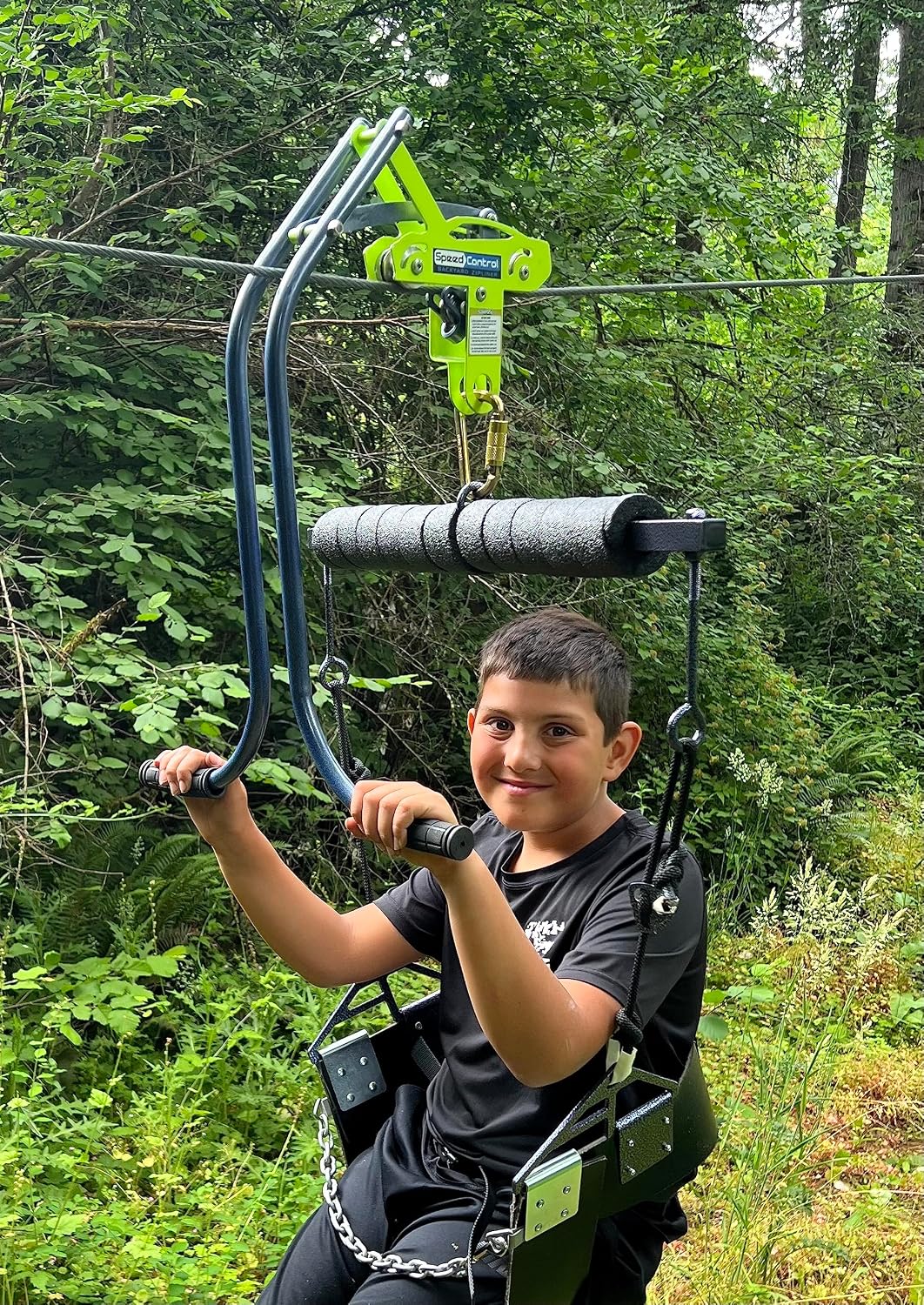
If you picked up a starter zipline kit — the kind sold as a complete package with everything you need to get riders moving between two trees — you already know the drill. You unbox a trolley (the wheeled carriage that rolls along the cable), a length of steel cable, a seat or handlebar, and a short lanyard (a connecting strap or rope that links the rider to the trolley so they don’t fall away from it). It all works. Kids love it. But somewhere around month three, maybe after a bigger teenager tries it or after the seat starts looking a little rough, you start noticing where the builder cut corners. The seat wobbles. The lanyard is uncomfortably short for adults. The handlebar grip is chewing up palms. This guide is for the moment you decide to do something about it — walking through which aftermarket upgrades are worth the spend, which specs actually matter, and how to match your choices to the span length and rider population you’re actually running.
Why Bundled Accessories Are Designed to a Price Point, Not a Performance Target
Starter kits in the $80–$250 range — think Slackers, SkyWalker, and ZipKrooz systems — are priced to move. Manufacturers hit a retail target by specifying components that meet minimum safety thresholds for the intended age range (usually kids 5–12, at posted weight limits of 100–150 lb), then trim elsewhere. That’s not a knock on those brands; it’s just the reality of consumer-packaged goods.
The consequence is that the trolley is often the best-engineered piece in the box — it’s a liability item, so factories spec it conservatively — while the seat, lanyard, and grip hardware absorb the margin compression. Per the CPSC’s Public Playground Safety Handbook, playground and zipline equipment must meet load ratings appropriate to the intended user, but “intended user” in a bundled kids’ kit does not mean the 200 lb dad who decides to try it, or the camp group with mixed-age riders ranging from 60 to 175 lb.
Once you’re buying components à la carte — sourcing from AnytimeZiplines, SkyHighZiplines, or Zip Line Gear — you’re making individual decisions about each accessory. The tradeoff map looks like this:
By the numbers:
| Component | Bundled kit spec (typical) | Aftermarket upgrade target |
|---|---|---|
| Seat WLL (working load limit) | 100–150 lb | 250–330 lb |
| Lanyard length | 12–18 in fixed | 24–48 in adjustable |
| Grip material | Molded plastic | Foam or rubber over steel core |
| Brake compatibility | Passive spring stop | Inline bungee or friction brake |
WLL (working load limit) is the maximum load a component is rated to handle in normal use — it’s different from breaking strength, which is typically 3–5× higher but is not the number you design to.
Seats and Harnesses: Matching the Accessory to the Rider and the Span
Strap Seats vs. Rigid Seats vs. Full Harness Systems
The most common bundled seat is a strap seat — a loop of nylon webbing, sometimes with a molded plastic or wooden spreader bar — rated for riders under 125 lb. It’s fine for a 7-year-old on a 75-foot backyard span. It is not fine for a 160 lb teenager on a 200-foot span with a meaningful sag angle, where exit forces at the brake end are significantly higher.
Strap seats with spreader bars (the next tier up, ~$25–$60 aftermarket) add a wider seating platform that distributes load across the hip rather than concentrating it at the thighs. Owners report meaningfully better comfort on spans over 100 feet, where ride time is long enough for the narrow webbing to become an issue. Look for ratings of at least 250 lb WLL and UV-stabilized polyester webbing — nylon stretches more under load and degrades faster with sun exposure.
Rigid molded seats with integrated mounting hardware — the style used in commercial installations and available from suppliers like Zip Line Gear — are the right call when you have repeat riders (camp or resort context), or when you’re serving a wide weight range. These are typically rated to 300–330 lb and bolt directly to a carabiner (a metal snap-link connector) or shackle connection point on the trolley. The spec sheets on these consistently note EN 15649 or ASTM F2970 compliance — those certifications are worth verifying because they signal the product was designed to an external standard, not just an internal one. Per ASTM International’s F2970-22 standard for aerial adventure courses, seating components on commercial-adjacent installations should be independently rated and traceable.
Full harness systems — chest-and-leg harnesses from manufacturers like Petzl or Kong — are appropriate when your span is over 300 feet, when rider speed at the brake zone exceeds roughly 20 mph, or when you’re operating in any commercial or semi-public context. Harnesses transfer braking and landing forces to the full torso rather than the rider’s grip and seat, which matters enormously at speed. Petzl’s technical documentation notes that body harnesses designed for zip lining must be rated for dynamic loading (sudden force spikes at braking) rather than just static load, which is a different engineering requirement than a simple strap seat.
Decision rule: If your span is under 150 feet and your heaviest regular rider is under 175 lb, an upgraded strap seat with a 250 lb WLL is likely sufficient. Over 150 feet, mixed-weight rider populations, or any commercial intent — go to a rated rigid seat or harness system.
Lanyards: The Most Overlooked Safety Variable in a Rider Upgrade
The lanyard is the strap or rope segment that connects the rider (through the seat or harness attachment point) to the trolley. Its job is to keep the rider from separating from the trolley in the event of a bump, a sudden deceleration at the brake end, or a momentary loss of grip. In bundled kits, lanyards are almost universally too short, made from low-grade nylon, and terminated with hardware that’s adequate but not confidence-inspiring.
What to Look for in a Replacement Lanyard
Length and adjustability: A 12-inch fixed lanyard works for a small child sitting in a strap seat. For an adult standing and holding handlebars, or for a rider of any size on a long span where the trolley may decelerate hard at the end, you want 24–36 inches of adjustable length. Adjustable lanyards with a slider buckle (a buckle that can be repositioned along the lanyard’s length while maintaining full load rating) are the cleanest solution. Static lanyards — fixed length — are fine if you know your rider population precisely; adjustable is better for mixed use.
Termination hardware: Look for rated carabiners — ideally ANSI- or CE-rated connectors, specified in kilonewtons (kN), which is the standard unit for fall-arrest hardware. 1 kN is approximately 225 lb-force. For a lanyard on a recreational zip line, a minimum gate-closed rating of 20 kN (roughly 4,500 lb-force) is what you’ll see on reputable equipment from suppliers like AnytimeZiplines. Bundled kit carabiners are frequently unrated — that’s not necessarily dangerous for light recreational use, but it means you’re flying blind on margin.
Shock-absorbing lanyards: For spans over 200 feet where riders may reach higher speeds, a lanyard with a sewn tear-web (a folded webbing section that unfolds progressively under sudden load to absorb energy) is worth considering. These are standard in the climbing and ropes course world — the ACCT’s ANSI/ACCT 03-2019 standard references energy-absorbing lanyards specifically for zip-tour operations. Petzl’s Connexion Vario lanyard is a frequently cited option in the ropes-course community; per Petzl’s own technical notice for that product, it’s rated for use in zipline configurations with a 140 kg (308 lb) user weight and provides progressive energy absorption. That’s a purpose-designed solution for commercial-adjacent setups.
Decision rule: For backyard recreational use with riders under 175 lb on spans under 150 feet, an adjustable nylon lanyard with rated carabiners at both ends is your upgrade target. For spans over 200 feet, frequent adult riders, or any camp or resort application, add an energy-absorbing lanyard to your spec sheet.
Grips, Handlebars, and Ride Comfort Accessories
This is the lowest-stakes upgrade category from a pure safety standpoint, and the highest-impact upgrade from a ride-experience standpoint. Bundled plastic grips are adequate but become slippery when hands sweat and genuinely uncomfortable after more than about 30 seconds of riding — which matters more as span length increases.
Foam over steel core grips — the kind sold as mountain bike or ropes-course handlebar replacements — are the standard aftermarket upgrade. They provide meaningful grip in wet conditions, reduce vibration transmission from the cable, and are significantly more comfortable over long spans. Operators at camps and eco-resorts consistently report that grip upgrades are among the highest-return simple improvements to rider satisfaction.
T-bar vs. straight bar vs. loop: T-bar configurations (a horizontal bar mounted perpendicular to the trolley drop line) allow riders to hang with arms slightly wider than shoulder-width, which is more stable and less fatiguing than a narrow straight bar. Loop designs — a closed oval that riders grasp from inside — are preferred for younger or less confident riders because they can’t accidentally slip a hand off the end. For family backyard installs with a wide age range, a loop or T-bar with foam grips is the one upgrade that will get used every single session.
Foot rests and stirrups: For longer spans — over 150 feet — foot pegs or stirrups that give riders something to push against at landing are worth considering. They reduce the tendency for riders to arrive at the brake end with legs dangling and no control over their posture. Saferparks’ zipline incident data identifies uncontrolled landings and rider posture at the brake zone as recurring contributors to minor injuries; stirrups are a simple mechanical intervention that addresses exactly that dynamic.
Putting It Together: A Decision Framework for Your Upgrade Budget
If you’re working with a $100–$200 accessory budget — realistic for an intermediate builder upgrading a completed kit — here’s a prioritized sequence:
- Lanyard first. Upgrade to an adjustable, rated lanyard with proper carabiners. This is the safety-critical item. ~$30–$60.
- Seat or harness second. If your riders exceed the bundled seat’s WLL, or if you’re running mixed ages and weights, a 250–330 lb rated rigid or strap seat is the next priority. ~$40–$100.
- Grips third. Foam over steel, T-bar or loop configuration. ~$20–$40.
- Foot pegs last. Only if your span is over 150 feet and landing control is a recurring issue. ~$20–$35.
If your build is trending toward commercial or semi-public use — even informally, like a summer camp or an Airbnb property where guests will ride — move the harness system to position one and add energy-absorbing lanyards before you open it to anyone other than household members. The ACCT and ASTM standards referenced above are the baseline; operators at that tier should also be consulting with a licensed challenge course inspector before first use.
The bundled hardware got you started. The aftermarket components get you to the version of the build you actually wanted.